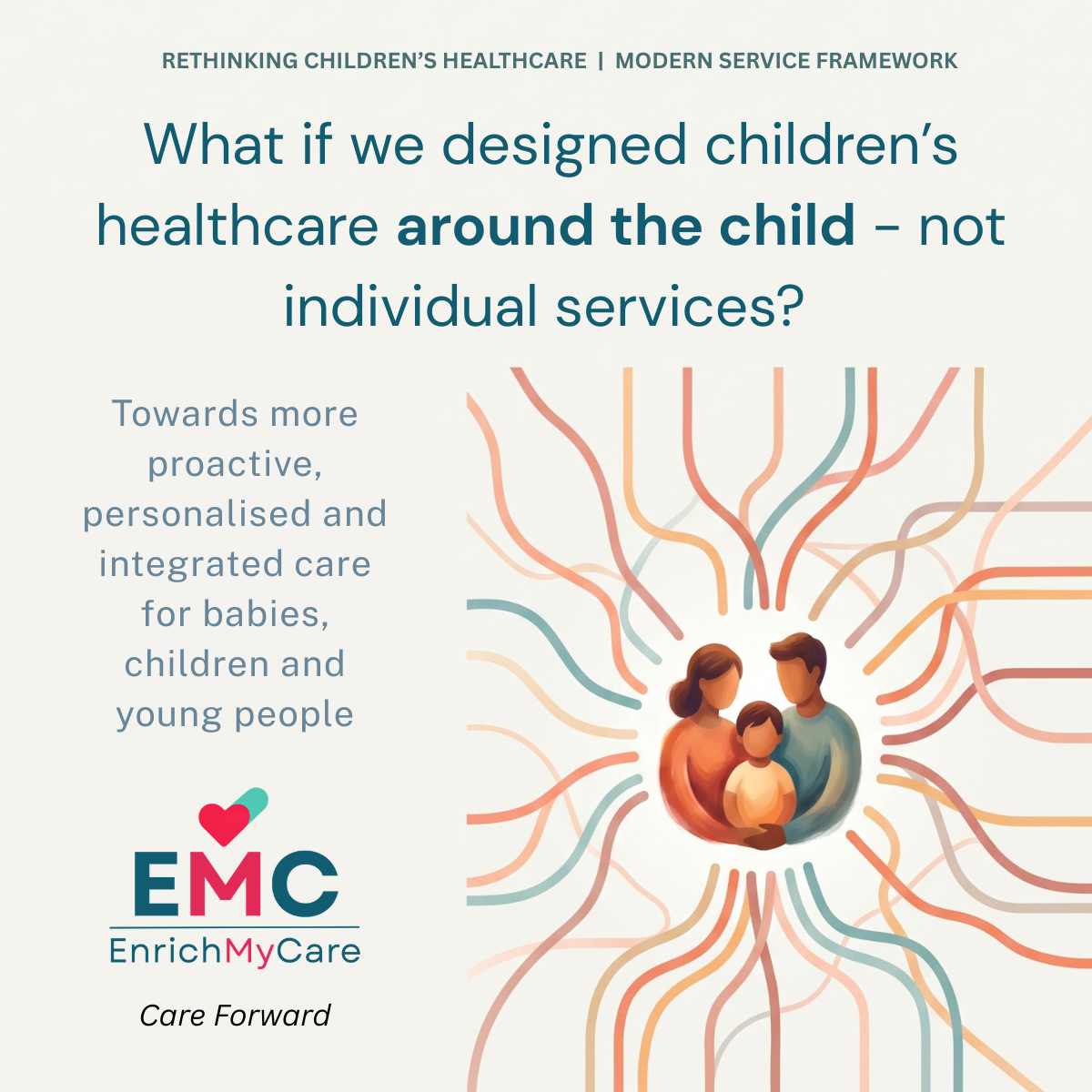
NHS England’s emerging Modern Service Framework for babies, children and young people creates an opportunity to rethink how care is organised — moving beyond individual services and towards more integrated, proactive and personalised care around children and families.
Children and families experience healthcare as a journey.
The health and care system, however, is often organised very differently.
A child may interact with community paediatrics, neurodevelopmental services, therapy teams, mental health services, hospital specialists, primary care, schools and social care. Each service may have its own referral processes, assessments, information requirements, appointments and digital systems.
These structures exist for understandable reasons. But from the perspective of a child or family, the boundaries between organisations and services can create fragmentation.
NHS England’s development of a Modern Service Framework for babies, children and young people aged 0–25therefore represents an important opportunity to think differently about how children’s healthcare is designed.
The emerging ambition is for care to become more proactive, personalised and integrated, with greater emphasis on prevention and early intervention, reducing inequalities and providing more coordinated support closer to home.
The question is how we translate those ambitions into the everyday experience of children, families and professionals.
Healthcare services are understandably designed around specialties, conditions and organisations.
Children’s lives are not.
A child with complex or long-term needs may simultaneously require support from several different teams. A young person approaching adulthood may need multiple paediatric services to coordinate with several adult services. A child undergoing neurodevelopmental assessment may require information from parents, schools, healthcare professionals and other agencies.
When those connections do not work effectively, families can become the informal integration layer between services.
They repeat information. They keep track of appointments. They explain what one professional has told another. They chase referrals and updates. They carry information between organisations.
Designing care around the child means asking a different question:
How should information, professionals and services come together around the needs of this child and family?
One of the recurring challenges across children’s pathways is not simply the volume of demand, but the quality and movement of information.
Incomplete referrals can generate additional administrative work. Missing information may require further contacts before clinical decisions can be made. Families and professionals may repeatedly provide information that already exists elsewhere.
These are not merely digital problems.
They are pathway-design problems.
Before introducing technology, we need to understand how demand enters a service, where information is collected, where decisions are made, where duplication occurs, where clinical capacity is consumed and where children wait.
Only then can we determine where redesigned workflows, better information exchange, automation or digital tools could make a meaningful difference.
Waiting times remain one of the major challenges facing children’s services.
But reducing waiting lists is only part of the challenge.
We also need to consider what happens while a child is waiting.
Can families provide relevant information as circumstances change?
Can appropriate resources and support be made available?
Can deterioration or changing needs be identified?
Can clinicians see meaningful information without creating additional administrative burden?
Can some activities that currently occur during appointments happen safely and appropriately beforehand?
A more proactive pathway should regard the waiting period as part of the care journey rather than simply the interval between referral and appointment.
There is understandable focus across healthcare on increasing capacity.
But capacity is not solely determined by the number of clinicians available.
We should also ask how existing clinical time is being used.
How much professional time is spent searching for information, collecting information that could have been available earlier, undertaking administrative coordination, reviewing inappropriate or incomplete referrals, or repeating activities performed elsewhere?
Pathway transformation should seek to remove unnecessary work while protecting the parts of care where professional expertise, clinical reasoning and human interaction matter most.
This is where well-designed digital workflow and automation can make an important contribution.
Artificial intelligence is increasingly entering healthcare, including children’s services.
There are potentially valuable applications: supporting information synthesis, referral processes, prioritisation, clinical workflows, monitoring and administrative automation.
But adding AI to an inefficient pathway does not automatically create an efficient pathway.
Nor does digitising an existing process necessarily transform it.
At EnrichMyCare, one principle increasingly guides our work:
Technology enables transformation. It doesn’t create it.
The starting point should be the clinical pathway and the outcomes we are trying to achieve.
Technology should follow.
That means understanding demand, capacity and flow, redesigning how care should work, and then determining where digital workflow, automation and AI can safely enable that redesigned model.
There will always be a need for specialist clinical pathways. Integration does not mean removing clinical specialism.
The opportunity is to make those pathways work together more effectively around the child.
That could mean information following the child rather than repeatedly being collected.
It could mean families contributing information once and making it available appropriately across their journey.
It could mean better connections between healthcare and schools.
It could mean clinicians seeing a more complete picture of the child before an appointment.
And it could mean transitions between services becoming planned processes rather than points where continuity is lost.
The objective is not one enormous pathway.
It is a more connected system of care around the child and family.
At EnrichMyCare, our work across children’s healthcare has increasingly reinforced a simple idea:
A future where care fits into life, not life into care.
Achieving that will require more than technology.
It will require clinicians, families, service leaders, commissioners, educators, technologists and other partners to redesign how care is organised and how information moves across traditional boundaries.
The development of NHS England’s Modern Service Framework provides an important opportunity to have that conversation.
EnrichMyCare has registered to contribute to the market engagement process, and we look forward to sharing our experience and learning from others involved in shaping the future of babies’, children’s and young people’s care.
Because ultimately, the measure of successful transformation should not be how many new systems we introduce.
It should be whether care works better around the lives of children and families.
Backed by Oxford University Hospitals

Institutional shareholder in Enrich Digital Technologies Ltd.
Working Across the NHS, Academic & Innovation Ecosystem








Our Assurance and Recognition
Meeting rigorous standards for safe, secure and clinically governed digital healthcare.





Developed and evaluated in partnership with NHS clinical teams.