When a service has a growing waiting list, the natural conclusion is that it needs more capacity. That may be true.
But the waiting list itself does not tell us why the system is under pressure.
Two services with identical waiting lists may have completely different underlying problems. One may have insufficient specialist workforce. Another may receive large numbers of referrals that could have been supported differently. Another may have sufficient theoretical capacity but lose significant clinical time to administration, incomplete information and repeated activity. Another may have bottlenecks concentrated at one particular decision point.
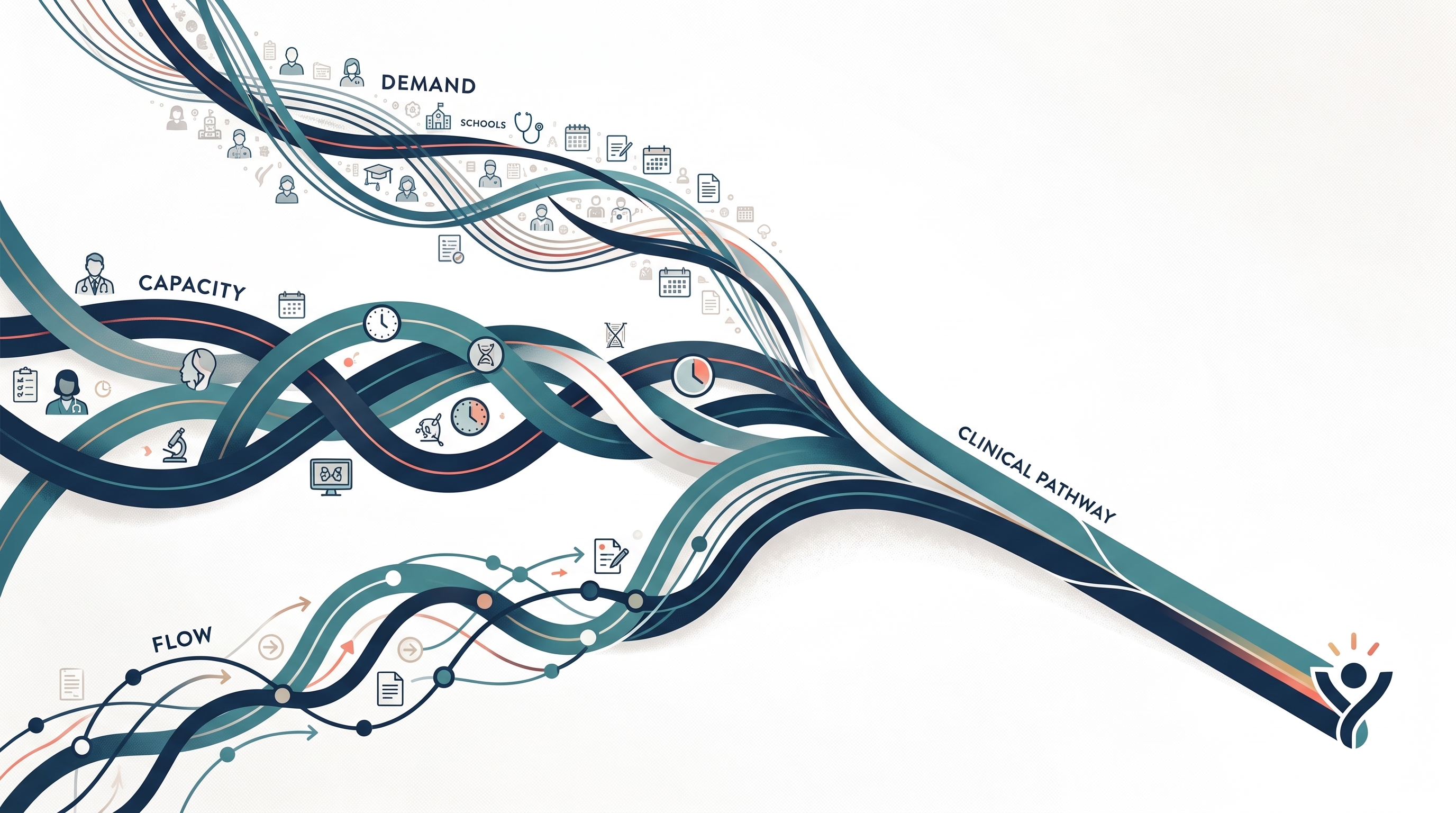
Before proposing a solution, we therefore need to understand three things together: Demand. Capacity. Flow.
Demand is more than the number of referrals received each month.
We need to understand where referrals originate, why patients are being referred, whether the right information accompanies them, how urgency and complexity vary, and how much activity is generated by incomplete or inappropriate referrals.
It is also important to identify what might be called failure demand — additional work created because something earlier in the pathway did not work as intended.
A missing piece of information can trigger correspondence. A poorly structured referral can require clinical clarification. A family that has heard nothing while waiting may contact the service repeatedly. A patient directed to the wrong part of the pathway may need to be redirected and reassessed.
All of this creates demand.
Understanding it changes the conversation from “How many referrals do we receive?” to “What work is the pathway actually generating?”
Capacity is also more than workforce numbers.
Two services with the same number of clinicians can have very different effective capacity depending on how those clinicians spend their time.
That is why pathway redesign needs to examine clinical activity in detail: how much time is spent in direct assessment, preparation, gathering information, documentation, administration surrounding clinical decisions, and activity that genuinely requires that level of professional expertise?
The purpose is not to label non-clinical activity as unimportant. It is to determine whether work is being undertaken by the right person, at the right point in the pathway, in the right way.
That is where opportunities to release clinical capacity often emerge.
Flow is the part that conventional activity reporting can easily miss.
A service may know how many referrals arrive and how many assessments are completed without fully understanding what happens between those points.
Patients wait. Information moves between organisations. Referrals are reviewed. Cases are discussed. Families complete forms. Appointments are scheduled. Some referrals are deferred. Some patients return for another appointment because information was unavailable the first time.
Each transition can introduce delay.
Mapping the pathway makes those movements visible.
And importantly, we distinguish touch time — when somebody is actively working on a case — from elapsed time — how long the patient actually experiences between stages.
A ten-minute task surrounded by a six-week queue remains a six-week experience for the family.
Demand affects capacity. Capacity affects flow. Poor flow can generate additional demand.
This is why pathway transformation needs to consider all three simultaneously.
Increasing capacity without addressing avoidable demand may provide temporary relief. Reducing referrals without understanding clinical need may create risk elsewhere. Automating one process without understanding downstream flow may simply move the bottleneck.
The pathway has to be treated as a system.
Our approach is deliberately diagnostic.
We establish a local baseline using the organisation’s own pathway data and the experience of the people who deliver and use the service.
That distinction matters because results from one NHS organisation cannot simply be assumed to apply to another. Our existing pathway work has demonstrated measurable improvements, including a 40% reduction in assessment time in the Derbyshire neurodevelopmental work, but Discovery is intended to establish a locally validated baseline before benefits are modelled for another service.
Only after that should the future pathway be designed.
Because the most useful question is rarely “Which intervention should we implement?” It is: “What is demand doing, where is capacity being consumed, and what is preventing patients from flowing through the pathway?”
Answer those three questions well, and the opportunities for meaningful transformation become much clearer.
Backed by Oxford University Hospitals
Institutional shareholder in Enrich Digital Technologies Ltd.
Working Across the NHS, Academic & Innovation Ecosystem






Our Assurance and Recognition
Meeting the highest standards for safe, secure and effective NHS delivery.